
Home › Projects › Laredo, Texas
Police & Fire · Staffing & Compensation
Laredo Comprehensive Public Safety Assessment
CPS assessed compensation, retention, and operations for the Laredo police and fire departments, benchmarking both against Texas peer municipalities and modeling five years of fiscal impact for a border city that also serves as the nation’s busiest inland port.
The engagement
What We Did
The City of Laredo retained The Center for Public Safety through a competitive procurement to examine its police and fire departments across compensation, benefits, retention, operations, and fiscal planning. Laredo occupies an unusual position among American cities. It is a community of roughly 261,000 residents spread across 106 square miles that also functions as the country’s premier inland port, handling more than 16 million vehicle crossings a year. That combination produces service demands and labor market conditions, including steady recruitment competition from federal agencies, that a population comparison alone will never capture, and the study was built accordingly.
The compensation work benchmarked the police department against twenty-one Texas municipalities and the fire department against seventeen, drawn from three tiers: border communities operating in comparable conditions, Texas cities of similar size, and the large metropolitan departments that set the upper bound of the statewide market. Every salary schedule was standardized to an annual equivalent before comparison, positioning was calculated at each stage of the career rather than at entry alone, and the review extended to total compensation, covering employer benefit contributions, retirement plan valuation, incentive and certification pay, and career earnings.
Operational analysis ran in parallel. The team reviewed more than 30,000 officer-initiated activity records across twenty-nine data fields for calendar years 2023 through 2025, examined 31,693 incident records spanning twenty offense categories, and evaluated patrol workload by beat, by hour, and by response time component. On the fire side, CPS measured response performance against NFPA 1710, assessed coverage across fifteen active stations carrying 35,919 emergency medical responses a year, and compared the shift configurations in use at peer departments.
Fiscal modeling paired a deterministic cost buildup with Monte Carlo simulation across 10,000 iterations, producing probability distributions and a sensitivity ranking over a five-year horizon. The finished assessment runs to twenty-one analytical chapters and seven priority recommendations, sequenced into immediate, short-term, medium-term, and long-term phases, with the benchmarking appendices and documented method left in a form the city can reapply in future budget cycles.
Related work
Other Engagements
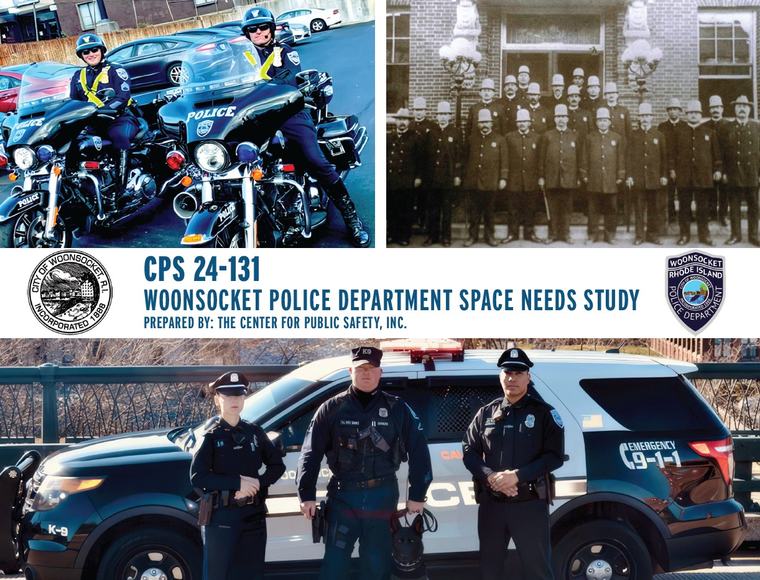
Woonsocket, Rhode Island
Woonsocket Police, Fire & 911 Space Needs Study
CPS programmed current and future space requirements for Woonsocket’s police department, a consolidated replacement fire station, and a regional 911 dispatch center, then priced seven facility configurations and continued with the city as owner’s representative.
View project
Deerfield Beach, Florida
Deerfield Beach Public Safety Feasibility Study
CPS evaluated whether Deerfield Beach should continue receiving law enforcement and fire rescue services under contract from the county sheriff’s office or establish independent municipal departments, modeling both options on the same basis across a twenty-year horizon.
View project
Lady Lake, Florida
Lady Lake Police Headquarters Planning Study
CPS completed an integrated planning study for the Lady Lake Police Department, combining a twenty-year staffing projection with room-by-room space needs assessments at the two building sizes the Town asked to see, 45,994 and 62,354 gross square feet, each priced to a probable project cost on the same 5.5-acre site.
View projectStart the conversation
Tell Us What Your Agency Is Facing.
Most agencies call us about a budget request, a growth pressure, or the start of a facility project. A short conversation is usually enough to tell you whether a study is the right next step, and what it would involve.